Access to markets, talent and finance remain the key barriers to scaleup growth across the UK, according to the Scaleup Institute’s latest annual report on the sector.
The Scaleup Annual Review 2025, published last month, surveyed businesses across the UK on the key barriers to high growth. Access to markets was the most frequently cited barrier (58 per cent), followed by talent and leadership (55 per cent), then finance (42 per cent).
The barriers remain similar to those in the Scaleup Institute’s first annual scaleup report, published in 2014. It identified talent, markets, finance, leadership and infrastructure as the top five growth barriers at the time.
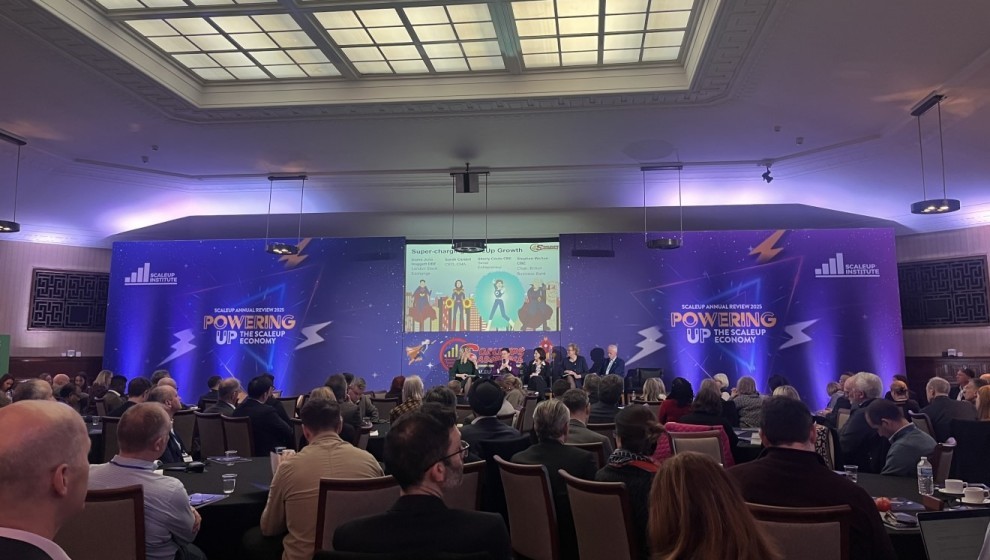
Addressing these long-standing issues was among the top discussion points at the Scaleup Institute’s Annual Conference, held in London on November 17, which launched the annual report and discussed key developments in the scaleup industry over the past year.
During a panel discussion, Dame Julia Hoggett, chief executive of the London Stock Exchange Group, analysed the current key issues for the sector.
She said: “Capital and procurement are the two things we need to fix. The government is going through a radical reform of our pension schemes, and you need the right structure of pension schemes including those that take risks.
“Too often from the investment community I hear ‘there is nothing to buy here’ - we need to get better at providing domestic backing for our companies.
This was underlined by Stephen Welton, chair of the British Business Bank, who suggested the UK could take inspiration from the US in its approach to investing in high-growth businesses for the long term.
He said: “The US has real expertise in this area and we need to look at their examples. If we are to build large-scale companies, we need to stay [invested in them] for the duration.”
In a panel debate about the opportunities and challenges for scaleup businesses in different areas of the UK, Lucy Armstrong, chair of the Port of Tyne, discussed skills issues. She suggested that ensuring the right people were leading high-growth businesses was as important as making growth capital available.
The Port of Tyne is a member of the 2050 Maritime Innovation Hub, a partnership of public and private sector partners to harness research and development and promote technological advancement, including through working with innovative scaleups.
Lucy said: “The founders of companies may not always be the best leaders when it comes to scaling up. There is a culture [in the UK] focused on grants and on the inventor, not on the businessperson.
“It is not just about funding, having good people and good plans and delivering them into a market to solve problems is just as important.”
Despite the barriers identified in the Annual Scaleup Review and Conference, the latest report shows that the number of scaleups in Lancashire has grown consistently over the past decade.
It showed an average annual increase in scaleup density of 2.8 over the past 10 years, meaning the county has gained an average of 2.8 more scaleups per 100,000 population each year over the past decade. In addition, the 61.8 scaleups per 100,000 in the latest report was also a significant increase on the 48.7 in last year’s scaleup report.
Read the full story about the growth of the Lancashire scaleup economy identified in the latest Scaleup Annual Review here.





The website uses cookies.
Some are used for statistical purposes and others are set up by third party services. By clicking 'Accept all & close', you accept the use of cookies. For more information on how we use and manage cookies, please read our Cookie Policy.