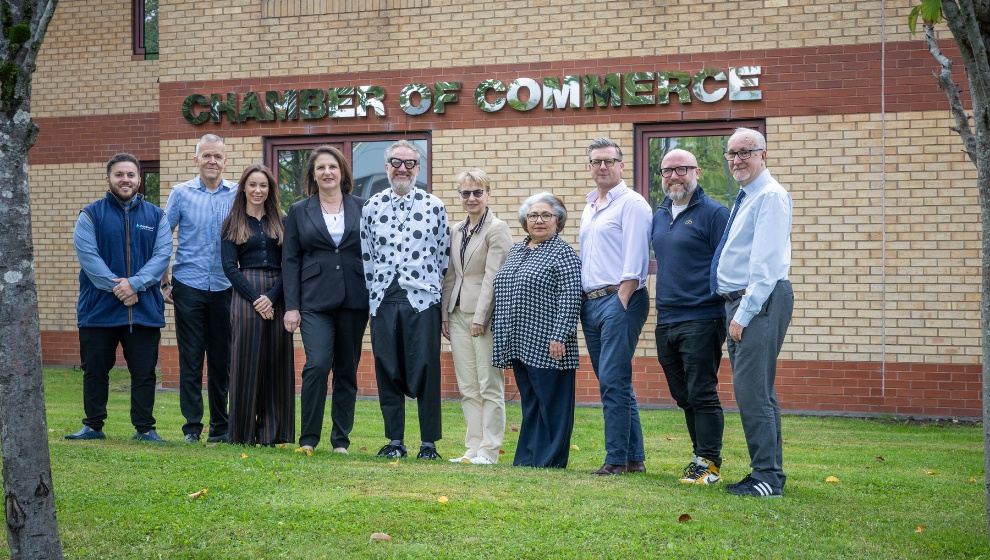
Boost brought together Lancashire business leaders, export specialists and support organisations to talk all things international trade.
Chaired by Andrew Leeming at the North and Western Lancashire Chamber of Commerce, participants discussed opportunities, challenges, practical realities and Lancashire’s potential to grow in global markets.
What are the biggest international opportunities and challenges for businesses right now?
Paul Walters, head of international trade, North and Western Lancashire Chamber of Commerce: “The biggest opportunity to me, from experience, is the fact we are British: brand Britain. British culture sells around the world. We need to sell on ourselves. It is against our nature, but we need to fight that nature. When I used to travel the world, I would always ask about the perception of Britain. The answer would always be that people love British products. We do not support our exporting at all, and it is what this country is built on, so I get frustrated.
Irma Vitoriano Gilbert, founder and CEO, ReddoAI Ltd (formerly E4-3D Engineering for Additive Manufacturing Ltd): “The biggest problem is finance. Growing our team to deliver maximum results in Brazil, the UK and Singapore, it is difficult to finance that. But Paul is right, one meeting I had with a Brazilian company, they asked, ‘What are you bringing to us that’s new?’. I said, ‘The best engineering technology the UK can provide for you’. That opened the door.”
Chris Panteli, operations manager, Engage Crop Solutions: “Costs are going up on our manufacturing sites due to energy; there needs to be a real focus on that. As a basic point, if you want to be competitive in the international market then your costs need to be low. We’ve had to change the way we do things. We used to conglomerate all our orders into one warehouse and dispatch from our warehouse; we cannot do that anymore. You are doing what you can to save money.”
Richard Few, founder and chief, Sales Geek: “For us the biggest opportunity has been the emerging markets. We have grown the fastest in Mongolia with India, Malaysia and Vietnam not far behind. Brand Britain, personally, I do not think is as strong as it used to be, and I think there is a danger of trying to trade off former glory.
“If we want to continue to be recognised on the world stage, it requires investment. We’ve also learned that ‘obvious’ things such as language and time zones do not necessarily make a market work. Anything can be overcome by great people who get things done, irrespective of what initial research says.”
Stephen Turner, founder, Group55: “Several factors are making export opportunities greater than they’ve been for some time. Alongside that, there’s reshoring and nearshoring, and there’s a really strong commercial case for both. It isn’t international trade in the traditional sense; it’s about winning back work that has moved overseas and bringing it home to UK manufacturers. It’s a nuanced point, but I think it’s an international opportunity that a lot of businesses can take advantage of.
“For the UK to thrive, we need to make things and make them well. I don’t believe we have a skills shortage in this country; what we have is an opportunity to invest more in skills and to develop the leaders who will drive that growth. Right now, a changing global landscape is opening up real opportunities for UK businesses. It would be a missed opportunity not to respond and build further support around them. Imagine what we could achieve if we really backed our entrepreneurs.”
Amy Blundell, operations manager, FYC For Your Curls: “Whenever I have explored any kind of funding or financial support, it has seemed more geared towards innovation as opposed to simply helping to scale a brand. Of course, there is an element of innovation in anything you do but really, it is hard to really evidence innovation from a technological point of view.”
What is the best piece of advice you would give to a business exploring international trade?
Malcolm Woodall, export finance manager, UK Export Finance: “If you are talking to anyone in the finance world, just make sure that individual is going to be an advocate for you and your business. I know we have discussed all the technological advancements that are to be tapped into, but business is still about people, particularly in a finance world.”
Gill Barlow, regional manager, Department for Business, Innovation, Science and Trade: “I would say make use of the support that is out there, whether that is government funded through us at the Business Academy, through business advisers, through Innovate UK, through the Chambers of Commerce, through the Growth Hub, or through the experience of people around the room who’ve seen it and done it. Take full advantage of the support that is available out there.”
Sirka Moore, business support specialist, RTC North: “International markets are not always the next step in a business's growth journey; sometimes they are the right place to start. The key is identifying where the best opportunities exist and making informed decisions based on market intelligence. While businesses have traditionally been encouraged to establish themselves in their home market before expanding overseas, this approach does not always deliver the best results.
"Companies should focus on the markets with the strongest demand, competitive advantage and growth potential. Although AI and digital tools have made market research more accessible, the challenge is turning information into practical business action. External support can provide valuable perspective, helping businesses identify opportunities and develop effective routes to market."
Paul Walters: “I would agree totally with that. Younger people setting up businesses, they don’t see the world the same as we did – they do not see barriers between countries’ walls. You can set up a business now and only export; you are better having a UK market, but you don’t have to. If you are new company, network, get to know people, find yourself a mentor.
“Look at where we have got trade deals; understanding the culture is as important as the pitch itself. There are lots of Lancashire companies making great products who do not export – and they should do. My job is to take that fear away from exporting. We are here to help, and it doesn’t matter about the size of the company.”
Amy Blundell: “Speak to someone that has already done it within the industry you are operating in. Today has been really useful for me. Also, where you start exporting to might not necessarily be the one that makes the most sense on paper - the opportunity might be somewhere a little bit different.”
Irma Gilbert: “We joined the innovation programme for Singapore and now there is an opportunity to join Brazil’s, because there is a relationship with the UK. At first, I wasn’t sure, but I went to Brazil in October and found that perception is sometimes not what you think. That changed my attitude and today our Brazilian market is the same size as America.”
Chris Panteli: “Through the Chartered Institute of Export & International Trade., we contacted a lady who was an expert in trading in South America. We sat with her for five hours and all she did was talk about the culture, how they operate, how to speak to them and how not to speak to them. That was probably one of the most insightful things we ever did. Learning those nuances is so beneficial.”
How well positioned is Lancashire to compete in international markets?
Gill Barlow: “I would agree that UK and Lancashire companies are unlikely to be competing on price; it is all about the quality, the innovation, the reputation that UK products have. Lancashire is in a brilliant position here because you’ve got so many innovation aspects here that can help you - like the AMRC, the Universities - to run you through the elements you need to be focusing on and what your USPs are when you’re selling overseas.”
Richard Few: “Blackburn is not as accessible globally as we would like but. in other ways, it is a great place to run and own a business from a lifestyle perspective and cost-based point of view. There is the opportunity now, with technology, to continue to do that and not be drawn into the metropolitan centres like businesses in the past.
“That said, those centres continue to incentivise businesses to move to them and if the more rural counties don’t find a way to compete with that, we will get brain drain out of the region – which could be a challenge for Lancashire. But those that take advantage of the advantages will be the best. We can give people an experience here that is as quintessentially British as you are going to get.
“They leave here with an experience you couldn’t give them if they flew into London. We take them to Lytham, to the Ribble Valley and we can only do that because Lancashire gives us the ability to. It creates a memorable experience and gets people off to the best possible start. They go back to their home nations with a level of energy and enthusiasm about the location and story behind the brand.”
Stephen Turner: “We are in a good position. We have a relatively low cost-base and a talented workforce. We’ve also got Lancastrian grit. We generally do it with humility and a lack of self-promotion. We have good infrastructure, we have talent and we have a voice that needs to be heard more. But we are in good shape. We have a work ethic, a drive and we should be positive. In the absence of funding and everything else, what have we got? Each other. We can put this on the record, as well. I think Boost do a brilliant job.”
Andrew Leeming, programme manager, Boost: “Boost Business Lancashire has an important role to play in bringing people together, and our latest roundtable sparked a valuable conversation about competing internationally and the opportunities and challenges facing Lancashire businesses.
“Accessing the right advice, connections and support can make a major difference. If you are based in Lancashire and looking to explore new markets and grow internationally, Boost is here to help. A big thank you to everyone who took part and shared their experience and insight. We look forward to our next roundtable – be sure to keep an eye out for details!”
Visit the Boost Business Lancashire website to find out what support is available to you and speak to the team about your growth ambitions.


The website uses cookies.
Some are used for statistical purposes and others are set up by third party services. By clicking 'Accept all & close', you accept the use of cookies. For more information on how we use and manage cookies, please read our Cookie Policy.